High mix, high precision manufacturing environments impose stringent requirements on metal cutting operations, including elevated productivity, reduced machining cycle times, and repeatable dimensional accuracy across a broad spectrum of materials.
ISCAR has developed a comprehensive portfolio of advanced metalworking solutions that address these challenges through innovations in carbide substrate metallurgy, multi layer coating architectures, modular tooling systems, application specific cutting geometries, and digital machining support.
The performance of cutting tools in high speed and high load machining is governed by the complex thermo mechanical interactions occurring at the chip–tool interface.
These interactions generate extreme contact pressures, localized temperatures exceeding 800–1000 °C, and severe abrasive, adhesive, and diffusion wear mechanisms.
ISCAR’s SUMOTEC technology addresses these challenges through the combined optimization of micro grain carbide substrates and multi layer Physical Vapor Deposition (PVD) and Chemical Vapor Deposition (CVD) coatings.
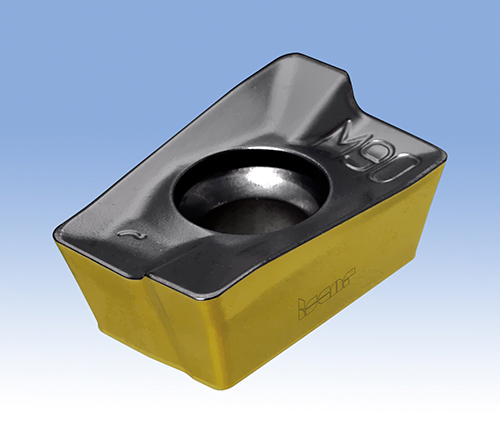
SUMOTEC PVD coated grades (Fig. 1) are designed for applications requiring sharp cutting edges and low cutting forces.
TiAlN and AlTiN based nano layer coatings provide high hot hardness and oxidation resistance while maintaining low friction at the chip–tool interface.
This minimizes built up edge formation and notch wear when machining austenitic stainless steels, nickel based superalloys, and titanium alloys.
The reduced thermal conductivity of the coating system limits heat transfer into the carbide substrate, thereby improving resistance to edge chipping and micro fracture under interrupted cutting conditions.
In contrast, SUMOTEC CVD coated grades employ thick, multi layer structures incorporating
TiCN and Al₂O₃ layers.
The Al₂O₃ layer acts as a thermal barrier, significantly reducing diffusion wear and plastic deformation at elevated cutting speeds.
These coatings are particularly effective in continuous and interrupted turning of ISO P and K materials, where crater wear and thermal softening dominate tool failure. The controlled coating adhesion and residual stress management ensure stable edge performance and predictable tool life in high volume production environments.
High mix manufacturing requires tooling systems capable of rapid reconfiguration without compromising rigidity or positional accuracy.
ISCAR’s LOGIQUICK modular tooling platform addresses this requirement through standardized mechanical interfaces that enable interchangeable cutting heads, extensions, and adaptors across multiple machining operations.
LOGIQUICK solutions, including LOGIQ 3 CHAM drills and modular turning toolholders, are engineered to provide micron level repeatability during tool changes.
The precision ground coupling interfaces ensure high torsional stiffness and bending resistance, even in applications with extended tool overhangs.
This mechanical integrity minimizes dynamic deflection and vibration, which are critical factors influencing surface finish and dimensional accuracy.
From a production standpoint, LOGIQUICK tooling reduces setup and changeover times by eliminating the need for tool requalification and offset recalibration.
The modular architecture also reduces tooling inventory and simplifies tool management, making it particularly advantageous in CNC machining centers and flexible manufacturing systems.
Drilling operations are inherently sensitive to tool deflection, chip evacuation efficiency, and thermal concentration at the cutting edges.
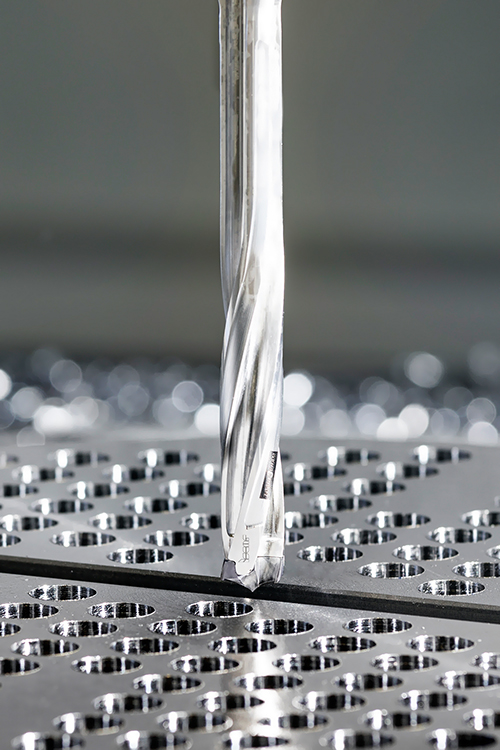
ISCAR’s LOGIQ-3-QUICK drilling system (Fig. 2) addresses these challenges through a hybrid design that combines a rigid carbide drill body with exchangeable solid carbide drilling heads.
LOGIQ-3-QUICK heads are manufactured with material specific geometries, including optimized point angles, margin widths, and cutting edge preparations tailored to ISO P, M, and S material groups.
The precision engineered internal coolant channels deliver high pressure coolant directly to the cutting zone, improving chip segmentation and evacuation while stabilizing cutting temperatures.
This design enables reliable drilling at depth to diameter ratios exceeding 5×D, even in difficult to machine materials.
Complementing LOGIQ-3-QUICK, ISCAR’s solid carbide drills featuring IC908 and IC948 grades provide enhanced wear resistance and torsional strength for high speed drilling applications requiring tight positional tolerances and superior hole quality.
Together, these hole making solutions reduce cycle time, improve hole straightness and surface finish, and significantly extend tool life.
ISCAR’s milling and turning technologies emphasize geometry optimization to control chip formation, reduce cutting forces, and enhance dynamic stability.
The HELI DO milling family incorporates double sided helical cutting edges that generate a gradual entry into the cut, reducing impact forces and suppressing chatter. The helical design promotes smooth chip flow and uniform load distribution along the cutting edge, making
HELI DO cutters suitable for heavy roughing and high engagement milling operations.
For high productivity milling, ISCAR’s FAST FEED cutters employ shallow axial depths of cut combined with extremely high feed rates.
This strategy minimizes radial cutting forces and spindle load while maintaining high metal removal rates.
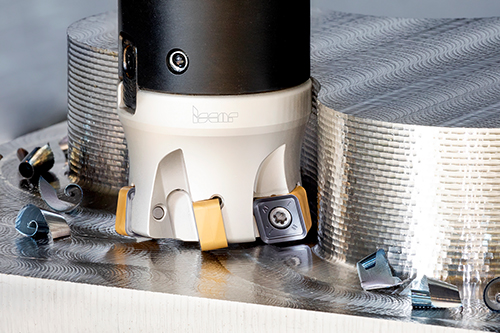
ISCAR's FAST FEED technology is particularly effective in pocket milling and roughing operations where cycle time reduction is critical (Fig. 3).
In turning applications, NEODO inserts utilize double sided negative geometries with reinforced cutting edges and advanced chip breaker designs.
These inserts offer high edge strength and thermal robustness, enabling stable machining in medium to heavy roughing operations involving steels and stainless steels. The increased number of usable cutting edges per insert also improves tool economy.
SCAR’s tooling solutions are complemented by advanced digital machining and process optimization platforms designed to support Industry 4.0 manufacturing strategies.
Tool selection and parameter optimization software utilize material databases, machine tool characteristics, and cutting mechanics models to recommend optimized machining strategies.
The use of digital twins enables predictive analysis of cutting forces, thermal loads, and tool wear progression, allowing engineers to identify optimal cutting parameters before machining begins.
This data driven approach reduces trial and error, enhances process repeatability, and supports standardized machining practices across multiple production facilities.
In aerospace machining of titanium alloys, the combined use of SUMOTEC coated turning inserts and HELI DO milling cutters has demonstrated tool life improvements of up to 40% and cycle time reductions of approximately 20%. These gains are attributed to improved thermal management, reduced cutting forces, and stable chip formation.
Automotive manufacturers which have recently applied LOGIQ-3-QUICK drilling systems in engine and transmission component production report consistent hole quality, extended tool life, and reduced tool change frequency, leading to improved overall equipment effectiveness.
In general engineering and subcontract machining environments, the implementation of LOGIQUICK modular tooling has resulted in substantial reductions in setup time and tooling inventory while maintaining tight dimensional tolerances and high surface finish quality.
ISCAR’s advanced metal cutting solutions provide a technically integrated approach to addressing the challenges of high mix, high precision manufacturing.
Through innovations in SUMOTEC carbide grades and coatings, LOGIQUICK modular tooling, SUMOCHAM drilling systems, and optimized HELI DO, NEODO, and FAST FEED cutting geometries, ISCAR enables manufacturers to achieve higher metal removal rates, improved tool life, and enhanced process stability.
As manufacturing continues to evolve toward digitally connected and data driven production systems, ISCAR’s combination of advanced tooling and digital support technologies offers a robust and scalable foundation for next generation metalworking operations.