


Page 33 - Demo
P. 33
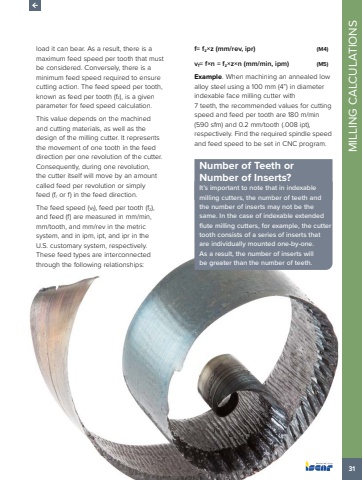
31MILLING CALCULATIONSload it can bear. As a result, there is a maximum feed speed per tooth that must be considered. Conversely, there is a minimum feed speed required to ensure cutting action. The feed speed per tooth, known as feed per tooth (fz), is a given parameter for feed speed calculation.This value depends on the machined and cutting materials, as well as the design of the milling cutter. It represents the movement of one tooth in the feed direction per one revolution of the cutter. Consequently, during one revolution, the cutter itself will move by an amount called feed per revolution or simply feed (fr or f) in the feed direction.The feed speed (vf), feed per tooth (fz), and feed (f) are measured in mm/min, mm/tooth, and mm/rev in the metric system, and in ipm, ipt, and ipr in the U.S. customary system, respectively. These feed types are interconnected through the following relationships:f= fz%u00d7z (mm/rev, ipr) (M4)vf= f%u00d7n = fz%u00d7z%u00d7n (mm/min, ipm) (M5)Example. When machining an annealed low alloy steel using a 100 mm (4%u201d) in diameter indexable face milling cutter with7 teeth, the recommended values for cuttingspeed and feed per tooth are 180 m/min (590 sfm) and 0.2 mm/tooth (.008 ipt),respectively. Find the required spindle speedand feed speed to be set in CNC program.Number of Teeth orNumber of Inserts?It%u2019s important to note that in indexable milling cutters, the number of teeth and the number of inserts may not be the same. In the case of indexable extended flute milling cutters, for example, the cutter tooth consists of a series of inserts that are individually mounted one-by-one. As a result, the number of inserts will be greater than the number of teeth.


